
A design agency portfolio is not just a gallery of attractive work. It is a sales tool. It tells potential clients what problems the agency solves, what type of clients it understands, what level of thinking sits behind the visuals, and why the agency should be trusted with a serious commercial project. A weak portfolio shows images. A strong portfolio builds confidence.
Enterprise clients and SaaS founders do not browse portfolios the same way casual visitors do. They are looking for proof of capability, category understanding, process maturity, and business relevance. They want to know whether the agency can handle complexity, communicate clearly, meet deadlines, and connect design decisions to measurable outcomes.

Think of the Portfolio as a Sales Funnel
A portfolio should guide the visitor from interest to trust. It should not force them to interpret a random collection of projects. The structure should answer the questions a serious buyer has before they contact the agency.
A useful portfolio funnel includes:
- Clear positioning
- Relevant proof
- Strong case studies
- Explanation of process
- Industry or service specialization
- Client outcomes
- Trust signals
- Clear calls to action
The goal is not to show every project ever completed. The goal is to show the right evidence in the right order.
Start With Positioning
Before showing work, the portfolio should explain what the agency does and who it helps. A visitor should understand the agency’s value within a few seconds. If the agency serves SaaS companies, enterprise teams, e-commerce brands, B2B platforms, media companies, or startups, say so clearly.
Weak positioning sounds like: “We create beautiful digital experiences.” Stronger positioning sounds like: “We help B2B SaaS companies turn complex products into clear, conversion-focused websites and brand systems.”
Good positioning answers:
- Who do you serve?
- What problem do you solve?
- What type of work do you deliver?
- What makes your approach different?
- Why should this client trust you?

Positioning helps the right clients recognize themselves. It also helps the agency avoid attracting poor-fit leads.
Build Case Studies, Not Image Dumps
A case study should tell a story. It should explain the client’s problem, the agency’s approach, the design decisions, and the outcome. Beautiful screenshots are important, but they are not enough. Serious clients want to understand how the agency thinks.
A strong case study structure includes:
- Client context
- Business challenge
- Project goals
- Constraints
- Strategy and concept direction
- Design system or production process
- Final deliverables
- Results or qualitative impact
- Lessons learned
This turns design work into evidence of problem-solving. It shows that the agency does not simply decorate. It solves commercial challenges through design.
Show the Process Without Overwhelming the Buyer
Process matters because it reduces perceived risk. Enterprise clients want to know how the agency works before they commit. SaaS founders want to know whether the team can handle fast iteration, stakeholder feedback, and product complexity.
The portfolio should show process clearly but not turn into a manual. Use concise sections that explain discovery, strategy, concept development, design execution, review, and delivery.
Useful process elements include:
- Research snapshots
- Moodboards
- Wireframes
- Design system components
- Before-and-after examples
- Collaboration structure
- Timeline overview
- Feedback and approval process
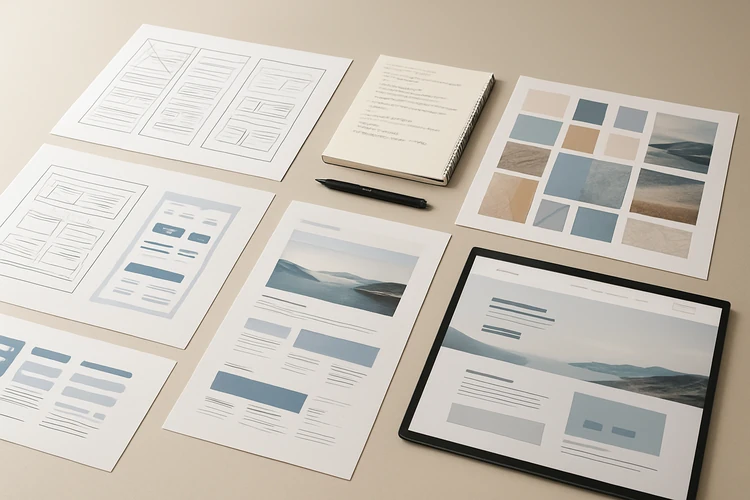
Process should reassure the buyer that the agency is organized and repeatable.
Create Separate Pages for Key Services
A multi-page portfolio is often stronger than a single page when the agency serves serious clients. Each service page can speak to a specific need: branding, web design, product design, pitch decks, content production, motion design, or design systems. This improves clarity and conversion because different buyers arrive with different problems.
Service pages should include:
- The problem the service solves
- Who the service is for
- What deliverables are included
- Example outcomes
- Relevant case studies
- Process overview
- Timeline or engagement model
- CTA for consultation
A founder looking for a SaaS website redesign should not need to search through unrelated logo projects. A marketing director looking for campaign assets should not need to interpret product UI examples.
Use Proof That Enterprise Clients Care About
Enterprise buyers often care about risk reduction. They want to know whether the agency can communicate with stakeholders, protect brand consistency, follow guidelines, and deliver reliably. Your portfolio should include trust signals that support this.
Useful proof signals include:
- Recognizable client names
- Industry specialization
- Testimonials
- Measurable outcomes
- Long-term client relationships
- Team expertise
- Clear process
- Security or confidentiality awareness
- Examples of complex deliverables

When possible, include numbers. Conversion lift, faster production time, improved engagement, reduced support confusion, or increased demo requests can make the portfolio more persuasive.
Design the Portfolio for Conversion
A portfolio can look beautiful and still fail to convert. Conversion depends on clarity, flow, relevance, and calls to action. The visitor should always know what to do next.
Conversion-focused portfolio elements include:
- Clear headline above the fold
- Strong service navigation
- Featured case studies
- CTA after each major section
- Contact form with relevant fields
- Fast-loading visuals
- Mobile-friendly layouts
- Short, specific copy
- Social proof near decision points
The CTA should match the buying stage. Examples include “Book a discovery call,” “Request a portfolio walkthrough,” “Discuss a project,” or “Get a proposal.”
Write Copy That Explains Value
Design agencies sometimes underwrite their portfolios because they assume the visuals speak for themselves. Visuals matter, but copy explains why the work matters. A potential client may not understand the strategic decision behind a layout unless the agency explains it.
Good portfolio copy should be:
- Specific
- Client-focused
- Outcome-oriented
- Easy to scan
- Free of vague creative cliches
- Connected to business value

Instead of writing “We crafted a beautiful brand identity,” explain what the identity needed to achieve: clarity, trust, differentiation, enterprise readiness, category positioning, or product comprehension.
Make It Easy to Contact You
A high-converting portfolio removes friction. If a visitor is ready to talk, they should not struggle to find the next step. Contact options should be visible, simple, and relevant to the type of work the agency wants.
A good contact page may ask:
- Name
- Company
- Website
- Project type
- Budget range
- Timeline
- Short project description
Avoid asking too many questions too early. The goal is to qualify the lead without making the form feel like a homework assignment.
Maintain the Portfolio Like a Product
A portfolio is not a one-time project. It should evolve as the agency’s positioning, services, and client base evolve. Review it regularly. Remove outdated work. Improve case studies. Add new proof. Test calls to action. Watch where visitors drop off.
Portfolio maintenance should include:
- Quarterly content review
- Updating featured projects
- Rewriting weak case studies
- Compressing images for speed
- Checking mobile experience
- Reviewing analytics and conversions
- Updating testimonials and proof
- Removing work that no longer fits positioning
Final Thoughts
A high-converting design agency portfolio is a strategic sales asset. It does more than display taste. It shows expertise, process, proof, and business understanding. For enterprise clients and SaaS founders, this matters because they are not buying visuals alone. They are buying confidence.
The strongest portfolios make the decision easier. They show who the agency helps, how it works, what results it can create, and why the buyer should start a conversation. When a portfolio does that well, it becomes one of the agency’s most valuable business development tools.