
Generative AI is no longer a novelty sitting outside the design industry. It is already inside moodboarding, concept exploration, asset production, image editing, layout testing, copy variation, presentation building, and campaign adaptation. For commercial design teams, the question is no longer whether AI will affect the workflow. The real question is how agencies can use it without losing strategy, taste, originality, and client trust.
Modern agencies should not treat AI as a replacement for designers. That framing is too simple and usually leads to poor results. The stronger approach is to treat generative AI as a production layer, research assistant, creative amplifier, and variation engine. It can speed up early exploration, remove repetitive tasks, and help teams test more directions before choosing the one that deserves human refinement.
Why Agencies Need to Adapt
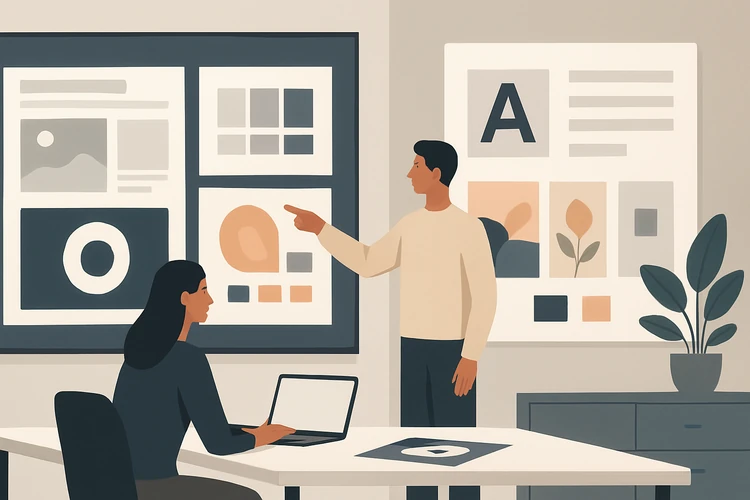
Design agencies work under pressure. Clients expect faster turnaround, more formats, more testing, more personalization, and more content across channels. A single campaign may require website visuals, ad banners, social graphics, email assets, pitch decks, thumbnails, product mockups, short video frames, and localization variations. Manual production alone can become a bottleneck.
AI helps agencies respond to this pressure by expanding the number of ideas and assets a team can explore in the same amount of time. It can also reduce the cost of early-stage experimentation. Instead of spending hours building polished drafts too early, designers can generate rough directions, compare them, and decide where to invest serious craft.
Generative AI can support:
- Moodboard creation
- Concept art and campaign direction
- Product mockup exploration
- Social media visual variations
- Background and texture generation
- Presentation visuals
- Image cleanup and expansion
- Style exploration for brand systems
- Fast adaptation of assets across formats
The advantage is speed, but the goal is not speed alone. The goal is better decision-making earlier in the creative process.
Start With Strategy, Not Prompts
A weak AI workflow begins with random prompting. A strong workflow begins with strategy. Before generating anything, the team should define the business goal, target audience, brand personality, competitive context, channel, format, and success criteria. Without this foundation, AI produces attractive noise.
The prompt should not replace the brief. It should translate the brief into visual direction. If the brief is vague, the output will be vague. If the brief is strategic, the output becomes easier to evaluate.
A useful pre-prompt checklist includes:
- Who is the target audience?
- What is the business objective?
- What emotion should the design create?
- What brand rules must be respected?
- What competitors should the work avoid resembling?
- What format and channel is required?
- What should the viewer do after seeing it?
- What visual references define the direction?
The Role of the Designer Changes
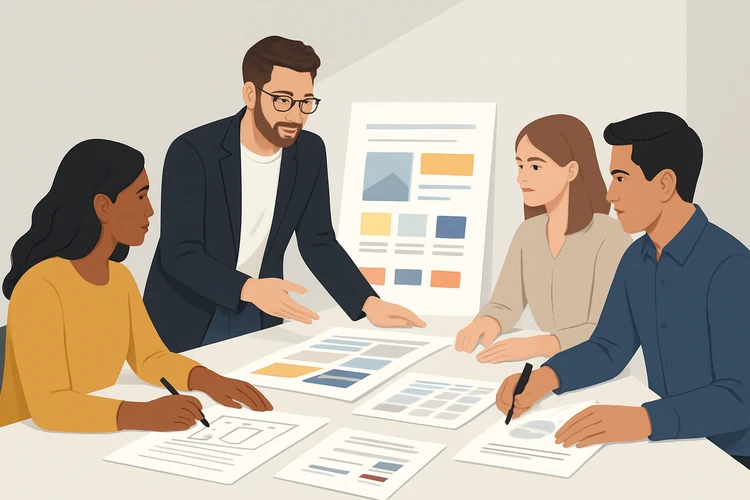
Generative AI changes the designer’s role from pure maker to creative director, editor, system builder, and quality controller. The designer still needs composition, typography, color judgment, brand thinking, visual hierarchy, and cultural awareness. In fact, those skills become more important because AI can produce many options, but it cannot reliably decide which option is right for the brand.
A designer using AI must know what to reject. That is the difference between production and taste. AI can generate a polished image that is strategically wrong, legally risky, visually generic, or inconsistent with the brand. Human judgment decides whether the output deserves to move forward.
In an AI-assisted workflow, designers often become responsible for:
- Translating briefs into visual systems
- Directing prompt strategy
- Selecting useful outputs
- Refining generated assets
- Maintaining brand consistency
- Checking originality and quality
- Preparing client-ready deliverables
- Documenting repeatable workflows
The best agencies will not be the ones that generate the most images. They will be the ones that build the strongest creative judgment around AI.
Where AI Fits in the Commercial Workflow
AI can be used at multiple stages, but it should not be used the same way everywhere. Early stages can be more experimental. Later stages need control, consistency, and quality assurance. Agencies should map where AI is useful and where human craft must dominate.
A practical commercial workflow might look like this:
- Research and references
- Moodboard and style exploration
- Concept directions
- Internal review
- Human refinement
- Client presentation
- Production adaptation
- Quality control
- Final export and documentation
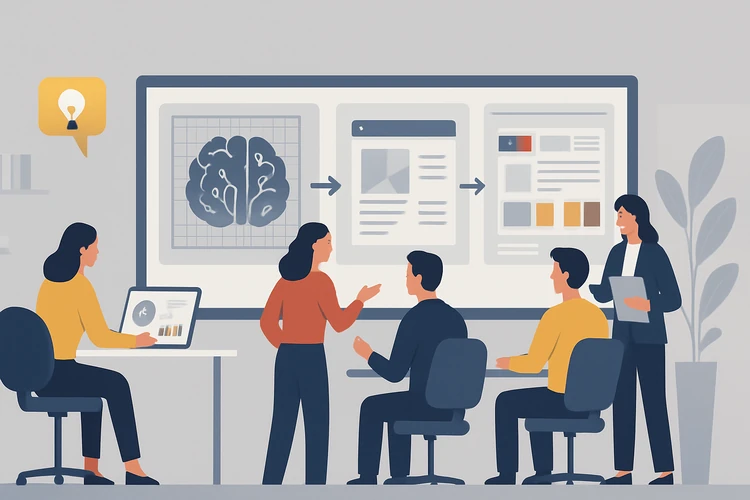
AI is strongest in the messy middle: exploration, variation, and asset preparation. It is weaker when the work requires exact brand discipline, precise typography, legal compliance, or final production accuracy.
Prompt Libraries and Reusable Systems
Agencies should not rely on individual designers improvising prompts from scratch every time. A mature AI workflow includes prompt libraries, style references, reusable templates, and internal examples of good outputs. This turns AI from a personal trick into an agency capability.
A prompt library may include:
- Brand mood prompts
- Product mockup prompts
- Social ad concept prompts
- Editorial image prompts
- Background texture prompts
- Presentation visual prompts
- Campaign variation prompts
- Negative prompts to avoid unwanted results
The library should also include notes about what worked, what failed, and which prompts are suitable for which client types. Over time, this becomes a valuable internal asset.
Brand Consistency and Quality Control
One of the biggest risks of generative AI is inconsistency. A campaign may look impressive in individual pieces but fail as a system. Different images may have slightly different lighting, style, proportions, or mood. For commercial design, that can damage brand coherence.
Quality control should include:
- Brand color alignment
- Typography consistency
- Visual style consistency
- Correct product details
- Human anatomy and object accuracy
- No unwanted text or fake logos
- No confusing cultural references
- No accidental similarity to competitors
- Correct export sizes and formats
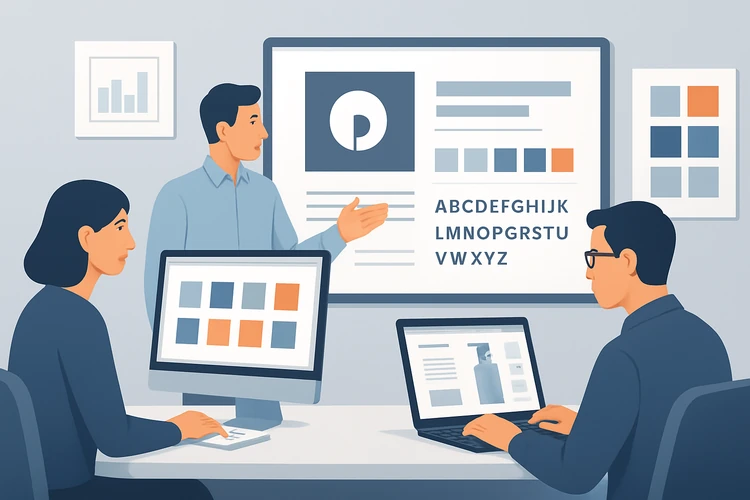
AI outputs should be treated like raw material. They need selection, editing, correction, and approval before they become client-facing assets.
Ethics, Rights and Client Transparency
Commercial AI workflows must consider rights, originality, and transparency. Clients may ask whether AI was used, whether generated assets are safe, and whether the work can be used commercially. Agencies should have a clear policy instead of improvising answers project by project.
A responsible AI policy should cover:
- When AI can be used
- Which tools are approved
- How prompts and outputs are stored
- How client data is protected
- Whether AI use is disclosed
- How final assets are reviewed
- What cannot be generated
- How copyright and licensing risks are handled
Agencies should avoid using confidential client material in tools that do not protect data properly. They should also avoid generating work that imitates living artists or recognizable copyrighted styles too closely.
Training Teams for AI Literacy
AI literacy is becoming a core agency skill. Designers, project managers, strategists, and account managers should understand what AI can do, what it cannot do, and how to speak about it with clients. Without training, teams may either overpromise or underuse the technology.
Training should include:
- Prompt writing basics
- Visual direction principles
- Tool limitations
- Brand safety checks
- Legal and ethical guidelines
- Workflow documentation
- Quality review standards
- Client communication
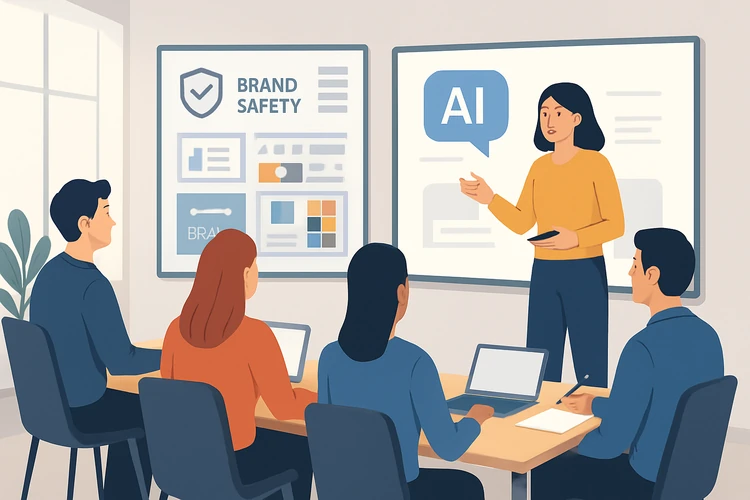
The agencies that benefit most will not simply buy AI tools. They will build repeatable processes around them.
Final Thoughts
Generative AI is reshaping commercial design, but it does not remove the need for designers. It raises the value of strategy, taste, editing, and systems thinking. Agencies that resist AI completely may become slower and less flexible. Agencies that use AI without discipline may produce generic work and lose trust.
The winning approach is balanced. Use AI for exploration, variation, and production support. Use human expertise for strategy, judgment, brand consistency, and final craft. When agencies master that balance, AI becomes less of a threat and more of a competitive advantage.