
Premium design assets can save hours of production time. A designer can download a font, icon set, presentation template, mockup, illustration pack, UI kit, texture library, or stock photo and instantly improve the speed and quality of a project. But every downloaded asset comes with legal conditions. Ignoring those conditions can create serious problems for freelancers, agencies, and clients.
Licensing is not the most exciting part of design work, but it is one of the most important. A beautiful asset used incorrectly can lead to takedown requests, client disputes, product delays, rework, or legal risk. Professional designers need to understand what they are allowed to do before placing an asset inside a client project, advertisement, website, product, template, or resale item.
What Copyright Means for Digital Assets
Copyright protects creative work. In design, that can include illustrations, fonts, icons, photography, templates, UI kits, video assets, motion graphics, music, 3D models, and other original files. When you buy or download an asset, you usually do not buy the copyright itself. You buy permission to use the asset under specific conditions.
This distinction matters. A downloaded asset is not automatically “yours” in the full legal sense. The creator or marketplace may still own the copyright. The license explains what you can and cannot do.
A license may define:
- Where the asset can be used
- How many projects it can be used in
- Whether client work is allowed
- Whether resale is allowed
- Whether modification is allowed
- Whether attribution is required
- Whether use in logos is allowed
- Whether use in apps, templates, or merchandise is allowed
- Whether the license is personal or commercial
The safest habit is to read the license before using the asset, not after the project is approved.
Personal vs Commercial Use
The first major distinction is personal use versus commercial use. Personal use usually means the asset can be used for non-business projects, practice work, school work, personal social media, or private experiments. Commercial use means the asset can be used in work connected to business, marketing, sales, client projects, or revenue.
A design agency should assume that most client work is commercial. Even if the final asset is not sold directly, it supports a business objective. A website, pitch deck, ad campaign, brand identity, product page, social campaign, or app interface is commercial by nature.
Commercial use may include:
- Client websites
- Marketing campaigns
- Product packaging
- Paid advertisements
- Social media assets for brands
- SaaS interfaces
- Presentations for sales
- Merchandise or printed materials
- Templates sold to customers
If a license says “personal use only,” do not use it for clients.
Royalty-Free Does Not Mean Free of Rules
Royalty-free is one of the most misunderstood licensing terms. It does not always mean the asset is free. It usually means that after you pay for the license, you do not need to pay a royalty every time the asset is used, viewed, printed, or distributed within the allowed terms.
A royalty-free stock image might be allowed on a website or ad campaign, but not allowed on a product for resale. A royalty-free icon set might be allowed in a client website, but not allowed inside a template you sell to other designers.
Royalty-free can still have limits on:
- Print quantity
- Audience size
- Number of users
- Number of projects
- Resale products
- Redistribution
- Use in trademarks
- Sensitive topics
- Modification
- AI training or dataset use
The phrase “royalty-free” should never be treated as a universal permission slip.
Standard Licenses vs Extended Licenses
Many marketplaces offer standard and extended licenses. A standard license is usually enough for common client work, websites, social posts, presentations, editorial graphics, and marketing materials. An extended license is often required when the asset becomes part of a product for resale or when usage scale is much larger.
A standard license may allow:
- Client marketing materials
- Website graphics
- Blog images
- Social media visuals
- Internal presentations
- Digital ads
- Limited print runs
- Modified use inside a broader design
An extended license may be required for:
- Merchandise
- Templates for resale
- Print-on-demand products
- Paid digital products
- Apps with embedded asset libraries
- Large print runs
- Assets used as the main value of the product
- Redistribution to multiple end users
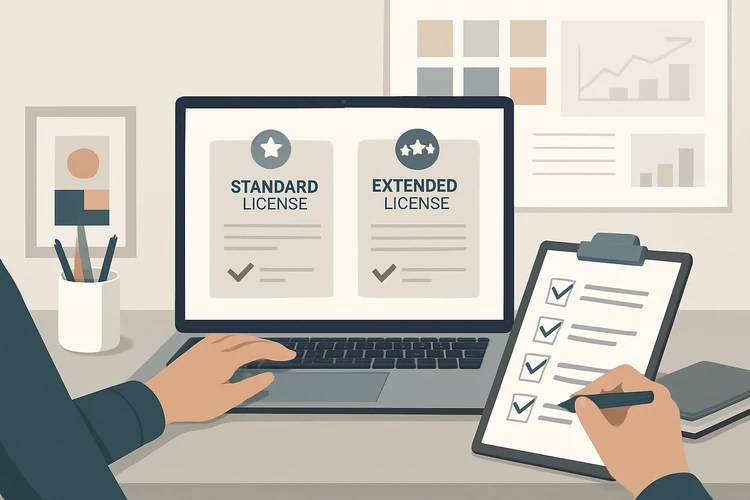
The key question is whether the asset supports the project or becomes the product. If it becomes a major reason someone buys the product, a standard license may not be enough.
Fonts Have Their Own Licensing Rules
Font licensing deserves special attention. Designers often install a font and assume it can be used anywhere. In reality, fonts may have separate licenses for desktop use, web embedding, app embedding, eBooks, servers, and logos.
A desktop font license may allow a designer to use the font in static designs, but not to embed it on a website. A webfont license may allow website use but limit monthly pageviews. An app license may be required if the font is embedded inside software.
Font licenses may cover:
- Desktop design use
- Webfont embedding
- App or software embedding
- eBook or PDF distribution
- Server use
- Logo use
- Number of users or seats
- Client transfer rights
If a client needs to continue using the font after delivery, the client may need their own license. Agencies should clarify this early.
Templates, UI Kits and Resale Risk
Templates and UI kits are especially risky because they can blur the line between using an asset and redistributing it. If you use a UI kit to speed up a custom client dashboard, that may be allowed under many commercial licenses. If you package the UI kit components into a template and sell it, that may violate the license.
The same applies to presentation templates, website templates, social media packs, icon bundles, and mockup files. You may be allowed to use them to create an end design, but not to resell the editable source files.
Ask these questions before using templates:
- Will the client receive editable source files?
- Will the asset be included in a product for resale?
- Is the downloaded asset still recognizable in the final product?
- Does the license allow redistribution?
- Does the license allow use by multiple client team members?
- Does the client need to purchase their own copy?
These questions prevent problems during handoff.
Creative Commons Licenses
Creative Commons licenses allow creators to share work under standardized conditions. They can be useful, but they require attention. Some Creative Commons licenses allow commercial use. Some do not. Some require attribution. Some require derivative work to be shared under the same license.
Common Creative Commons conditions include:
- Attribution required
- Non-commercial use only
- No derivatives allowed
- Share-alike requirement
- Public domain dedication
For client work, Creative Commons assets can be risky if the attribution requirement does not fit the project or if commercial use is restricted. A client may not want visible credit on an ad, product page, or brand campaign. In that case, a different asset or paid license may be better.
What Agencies Should Track
Agencies need a licensing workflow. It is not enough for each designer to remember where an asset came from. Projects move between people, clients ask questions later, and files may be reused months after the original download.
A licensing record should include:
- Asset name
- Creator or marketplace
- Purchase date
- License type
- Permitted usage
- Client or project name
- Invoice or receipt
- Link to license terms
- Any restrictions
- Whether client needs a separate license
This documentation protects both the agency and the client.
Final Thoughts
Licensing is part of professional design responsibility. Premium assets can improve speed and quality, but they must be used within the terms set by the creator or marketplace. Personal use, commercial use, royalty-free, standard licenses, extended licenses, Creative Commons, font embedding, and resale rights all mean different things.
The safest approach is simple: read the license, document the source, match the permission to the project, and clarify client rights before delivery. When designers treat licensing as part of the workflow, they reduce risk and build trust. Good design is not only beautiful. It is also legally safe to use.